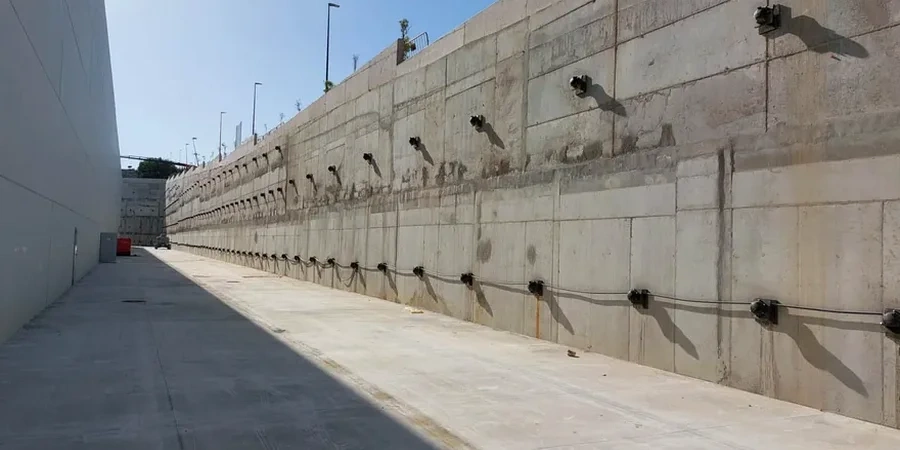
The flat fen-edge landscape around Cambridge conceals a layered geology that challenges even well-planned retaining structures. With the Cam river cutting through the city centre and groundwater perched in the River Terrace Deposits, excavation support here rarely follows a textbook case. We see tie-back anchors working in stiff Gault Clay at the Addenbrooke’s biomedical campus, while passive ground anchors stabilise sheet piles along the Chesterton sidings.
The difference between active and passive systems matters most when adjacent buildings are Grade II listed and only a few metres from the excavation line. Before committing to a shoring layout, we usually recommend a CPT test to map the clay-to-gravel transition and identify any sand lenses that could bleed grout during installation. When the borehole log shows highly plastic clay, the anchor bond length can double the figure that a textbook formula would suggest.
A 15-metre active anchor in Cambridge Gault Clay typically carries a working load of 250–350 kN after proving to 1.25 times that figure on site.