GEOTECHNICAL ENGINEERING1
CAMBRIDGE
HomeRoadwayFlexible pavement design

Flexible Pavement Design in Cambridge: Site-Specific Engineering for Fenland Soils

Evidence-based design. Reliable delivery.

LEARN MORE

Cambridge’s expansion from a medieval market town on the River Cam into a modern innovation hub has placed immense pressure on its transport infrastructure. The city’s geology is deceptively complex: beneath the historic colleges and new fringe developments lies a patchwork of Gault Clay, river terrace gravels, and compressible fenland peat stretching toward the north. These formations present starkly different support conditions for road construction, making a standard flexible pavement design entirely unsuitable without localized investigation. The technical team approaches each scheme by mapping the transition between the stiff clays of the western uplands and the soft alluvial deposits east of the Midsummer Common, ensuring the pavement structure remains resilient to both seasonal moisture variation and the heavy bus traffic that characterizes Cambridge’s streets. This analytical rigor, supported by laboratory data and field correlation, helps developers meet the strict adoption standards of Cambridgeshire County Council without over-engineering the pavement layers.

Road failure in Cambridge is rarely a single event; it is the slow accumulation of subgrade deformation in soils that were never adequately characterized before the asphalt was laid.
Our service areas

How we work

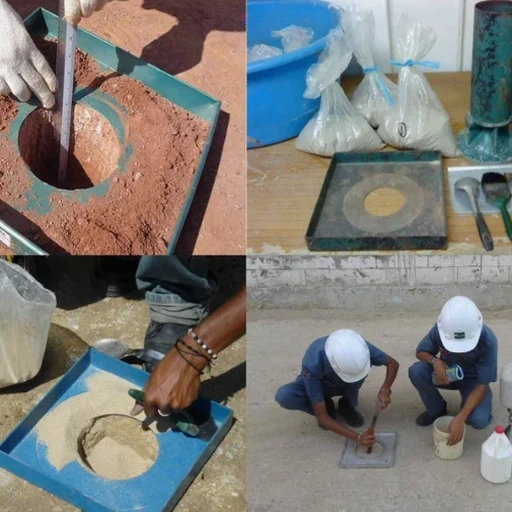
A recent project on the southern fringe near Addenbrooke’s Hospital required pavement design across a site where trial pits revealed 1.8 meters of made ground overlying Gault Clay with a perched water table at 1.2 meters. The granular sub-base alone would have been compromised without drainage intervention. The response combined a CBR road investigation to establish the soaked bearing capacity of the formation with a targeted grain size analysis of the imported capping layer to verify compliance with Series 800 of the Specification for Highway Works. Layer coefficients were adjusted in the analytical model to reflect the actual resilient modulus of the locally sourced aggregate, rather than relying on generic catalog values. This forensic approach to flexible pavement design—testing the materials you actually intend to use, under the moisture conditions the road will actually endure—is what separates a durable carriageway from one that begins rutting within three winters.
Flexible Pavement Design in Cambridge: Site-Specific Engineering for Fenland Soils
Technical reference — Cambridge

Local considerations

Eurocode 7 (BS EN 1997-2:2007) mandates that the ground investigation must provide sufficient data to select characteristic values for the subgrade—yet in Cambridge, the fenland edge creates a risk profile that generic sampling plans rarely capture. The most consequential failure mode for a flexible pavement here is differential settlement where a road transitions from gravel terrace onto peat-filled paleochannels, a scenario encountered repeatedly in the Chesterton and Abbey wards. The pavement beams longitudinally, the bound layers crack, and water ingress accelerates structural collapse. Mitigating this requires more than a standard CBR at formation level; it demands a longitudinal profile of the subgrade stiffness, interpreted with geological context and supplemented by consolidation testing where organic soils are identified. The cost of this upfront investigation is negligible when measured against the contractual exposure of a failed Section 38 adoption inspection.

Need a geotechnical assessment?

Reply within 24h.

Email: contact@geotechnical-engineering1.com

Regulatory framework

BS 5930:2015+A1:2020 – Code of practice for ground investigations, BS EN 1997-2:2007 (Eurocode 7) – Geotechnical design: Ground investigation and testing, DMRB CD 226 – Design for new pavement construction, MCHW Series 800 – Specification for Highway Works: Road Pavements, BS EN 13108 series – Bituminous mixtures – Material specifications

Typical values

ParameterTypical value
Design StandardDMRB CD 226 (formerly HD 26/06), BS EN 1997-1:2004
Subgrade ClassificationCohesive soils: long-term drained CBR; granular soils: relative density and friction angle
Adoption AuthorityCambridgeshire County Council (Section 38/278 agreements)
Traffic Loading Range0.1 to >80 million standard axles (msa)
Typical Layer SystemsSurface course, binder course, asphalt base, granular sub-base, capping (if CBR <5%)
Key Laboratory TestsCBR (soaked 96h), Atterberg limits, compaction (4.5 kg rammer), PSV for surface aggregate
Foundation Class TargetClass 2 or Class 3 per IAN 73/06 for adoptable roads

Questions and answers

What is the typical cost for a flexible pavement design package in Cambridge?

The fee ranges from £1.190 for a straightforward residential cul-de-sac with good subgrade to £4.620 for a major distributor road requiring extensive laboratory testing, multiple boreholes, and a full analytical pavement design report. The scope of ground investigation is the primary cost driver.

What CBR value does Cambridgeshire County Council require for adoptable roads?

The council generally expects an equilibrium CBR of 2.5% or higher at formation level for residential roads without capping. If the CBR is below 5%, a capping layer is required to establish a suitable foundation class, in accordance with DMRB CD 226 and the council's local technical standards.

How do you address the high water table in parts of Cambridge?

We design the pavement drainage system in parallel with the structural layers. This often involves a granular sub-base acting as a drainage blanket, connected to positive outfall, and the use of a geotextile separator to prevent fines migration from the subgrade into the sub-base under fluctuating groundwater conditions.

Can you design a flexible pavement on fenland peat?

It depends on the peat thickness and its consolidation characteristics. For thin peat layers, removal and replacement with engineered fill is typical. For deeper deposits, we may recommend a combination of surcharging with staged construction or a lightweight aggregate sub-base to reduce the bearing pressure, always supported by oedometer testing and settlement analysis.

What is the difference between a flexible and a rigid pavement design?

A flexible pavement distributes wheel loads through a layered system where each layer transmits stress to the one below, relying on the subgrade for ultimate support. A rigid pavement uses the flexural strength of concrete to bridge minor subgrade weaknesses. Flexible pavements are the standard for UK local authority roads due to lower initial cost and ease of staged maintenance.

Location and service area

We serve projects in Cambridge and surrounding areas. More info.

View larger map