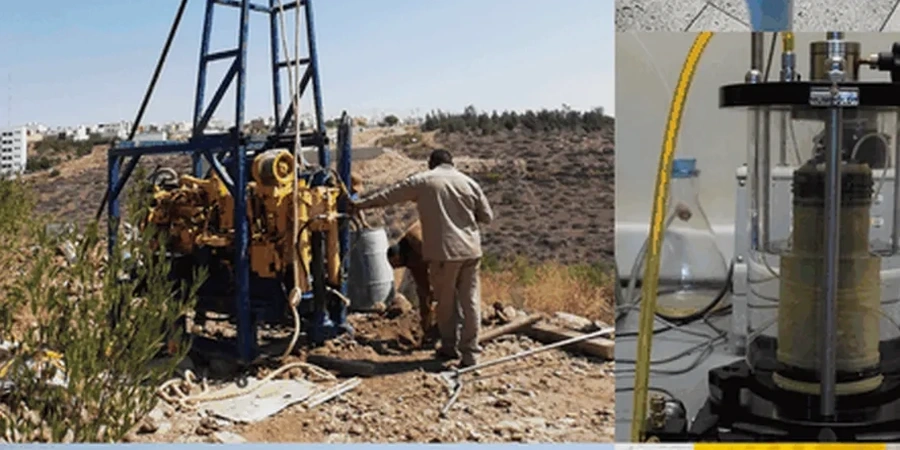
Cambridge grew from a Roman river crossing on the Cam, but below its medieval colleges and modern science parks lies a patchwork of river terrace gravels, Gault clay, and thick alluvial silts. The historic centre sits largely on the second terrace — reasonably competent — yet the expansion into the fens and former chalk quarry zones to the east and south regularly encounters loose granular fills and soft floodplain deposits. That is where vibrocompaction design becomes a practical first-choice solution. Rather than excavating and replacing cubic metres of weak fill, we specify a densification grid that turns loose sands into a reliable bearing stratum. A CPT test before treatment maps the initial state precisely, and a follow‑up cross‑hole survey confirms the target relative density has been achieved across the entire site.
In Cambridge's fen-edge sands we routinely achieve relative densities above 70% with a 130 kW vibroflot, verified by CPT before and after.