GEOTECHNICAL ENGINEERING1
CAMBRIDGE
HomeGeophysicsElectrical resistivity / VES (Vertical Electrical Sounding)

Electrical Resistivity Surveys / VES (Vertical Electrical Sounding) in Cambridge

Evidence-based design. Reliable delivery.

LEARN MORE

Cambridge's evolution from a Roman river crossing to a global centre of learning has left a layered legacy beneath its streets, where medieval quaternary deposits overlie the Gault Formation and the deep Chalk Group that defines the region's hydrology. When new college expansions or biomedical campus facilities break ground, the real challenge lies in what cannot be seen: variable thicknesses of alluvium, head deposits, and potential collapse features in the chalk itself. Our approach integrates Vertical Electrical Sounding with site-specific geological mapping to map these transitions before a single borehole is positioned. We combine this with CPT testing when the stratigraphy demands a mechanical calibration of the resistivity profile, and we often run a MASW survey in parallel to tie stiffness contrasts directly to the geoelectric layers.

In Cambridge, a resistivity survey is often the fastest way to trace the chalk surface where it undulates more than five metres across a single building footprint.
Our service areas

How we work

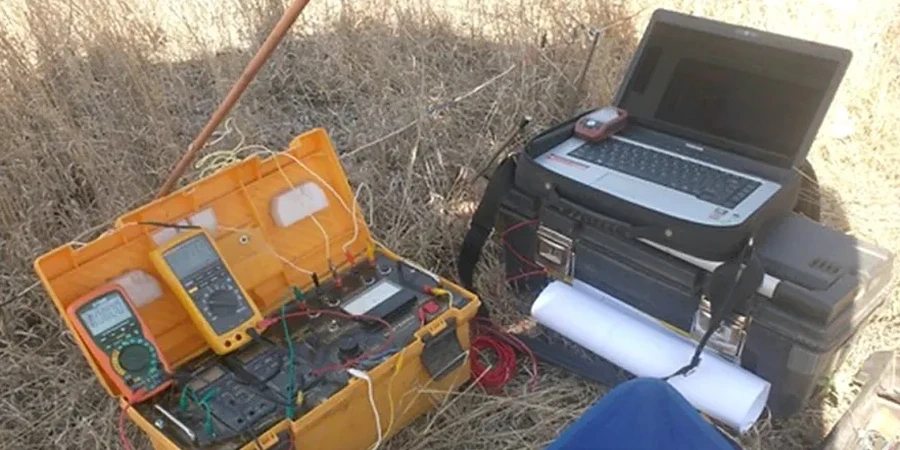
On a recent project near the West Cambridge site, a proposed research building showed surface gravels that masked a 7-metre band of soft Gault clay, which conventional probing had missed entirely. We deployed a Schlumberger array across three parallel transects, reaching an investigation depth of 45 metres, and the resistivity inversion revealed a discrete low-resistivity trough running diagonally under the northwest corner of the footprint. That single finding allowed the structural team to shift the pile group layout and avoid costly redesign six weeks later. In practice, we run the vertical electrical sounding with electrode spacings from 2 to 100 metres, capturing both the near-surface drift and the deeper chalk interface where dissolution pipes and perched water tables are common in this part of East Anglia. The data is processed with solid inversion algorithms and delivered as 2D tomograms and layer models that feed directly into the ground investigation report.
Electrical Resistivity Surveys / VES (Vertical Electrical Sounding) in Cambridge
Technical reference — Cambridge

Local considerations

The Cambridge chalk is not a uniform block of limestone; it behaves as a karstic aquifer with solution features, variable fracture density, and buried channels filled with low-resistivity clays. When a resistivity survey is omitted, the borehole log from one corner of the site gets extrapolated across the entire plot, and that is where the risk compounds: a two-metre variation in chalk depth can shift a piled foundation from end-bearing into socketed rock, doubling the contractor's programme. We have seen projects on the northern fringe of the city, near the River Cam floodplain, where peat lenses and soft alluvium created a resistivity signature below 15 Ω·m, completely invisible from the surface. The BS 5930 ground investigation framework explicitly recognises geophysical methods as an essential desk-study tool, and in low-lying areas of Cambridgeshire the resistivity contrast between granular terrace gravels and the underlying impermeable Gault is what allows us to map groundwater pathways with confidence.

Need a geotechnical assessment?

Reply within 24h.

Email: contact@geotechnical-engineering1.com

Regulatory framework

BS 5930:2015 + A1:2020 Code of practice for ground investigations, Eurocode 7 (BS EN 1997-1:2004 + UK National Annex), BS EN 1997-2:2007 Geotechnical design — Ground investigation and testing, ISO 17025 (accredited laboratory procedures)

Typical values

ParameterTypical value
MethodVertical Electrical Sounding (VES) / Electrical Resistivity Tomography (ERT)
Array configurationSchlumberger, Wenner, dipole-dipole
Maximum investigation depthTypically 40–60 m (site-dependent)
Electrode spacing2 m to 100 m, adjustable
Data output2D resistivity tomograms, 1D layer models, ISO 17025 report
StandardBS 5930:2015 + A1:2020, Eurocode 7 (BS EN 1997)
Typical applicationChalk interface mapping, groundwater detection, clay thickness

Questions and answers

What depth can a resistivity survey reach in the Cambridge area?

With a standard Schlumberger array and a maximum current-electrode separation of 200 metres, we can typically resolve layers down to about 40 or 50 metres. The actual penetration depends on the local geology: the high-resistivity chalk allows deeper current flow, whereas saturated Gault clay limits effective depth. We always model the expected current penetration during survey design.

How much does an electrical resistivity survey cost in Cambridge?

For a typical VES survey with three to five sounding points on a single residential or small commercial plot around Cambridge, the cost ranges from £450 to £900, depending on access, array length, and reporting requirements. Larger ERT transects or multi-line surveys are quoted based on the number of electrode positions and the site conditions.

Can resistivity testing distinguish between chalk and overlying gravels?

Yes, and that is one of its strongest applications in this region. Clean chalk typically shows resistivity values above 100 Ω·m, while dry terrace gravels can exceed 200 Ω·m. The key is that gravels are usually thin, so the resistivity drop at the chalk interface appears as a clear inflection in the VES curve, especially when calibrated with a single borehole or trial pit.

How long does a VES survey take and will it disrupt the site?

A single vertical electrical sounding with four electrode spreads takes roughly 45 minutes to an hour on site, plus processing time. The method is entirely non-invasive: we lay cables and insert small steel electrodes a few centimetres into the ground, so there is no drilling, no vibration, and no damage to paved surfaces. We can work around existing structures and occupied buildings without interrupting operations.

Location and service area

We serve projects in Cambridge and surrounding areas.

View larger map