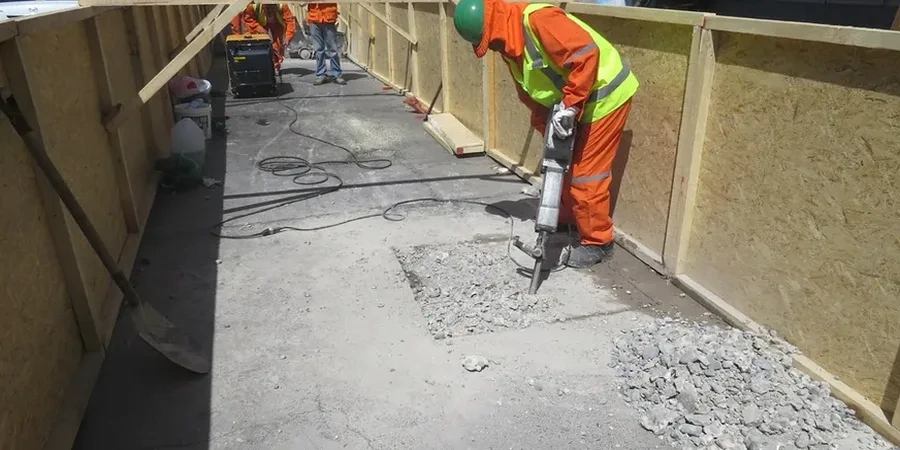
A deep basement excavation off Huntingdon Road last autumn ran into a classic Cambridge problem: Gault Clay at 4 metres, but the shear wave velocity profile was anything but uniform. The contractor had assumed a generic VS30 of 220 m/s for the foundation design. Our crew ran a 69-metre MASW line across the site and measured 195 m/s in the upper 8 metres, dropping to 180 m/s where the weathered clay transitioned into the underlying Woburn Sands. That 15% difference pushed the site from ground type D to a borderline D/E classification under BS EN 1998-1, triggering a redesign of the pile caps. When you are working on the Cam valley's complex Quaternary geology, generic assumptions cost money. We combine the MASW profile with seismic microzonation analysis when the project sits near the river corridor, where alluvial silts and peat lenses can create sharp velocity contrasts over distances as short as 30 metres.
A measured VS30 of 180 m/s versus an assumed 220 m/s in Cambridge Gault Clay can shift your seismic classification from D to borderline D/E, and that changes everything in the foundation budget.